
Myrtle Beach Directory Editions
Only a few historic Myrtle Beach directory editions are documented in the research. Institutional bibliographies name Hill's Myrtle Beach City Directory for 1959 and R. L. Polk & Co.'s Myrtle Beach, South Carolina City Directory for 1959 and 1965. Those citations establish titles, publishers, and dates. They do not establish an unbroken annual run, a present shelf location, or that every edition contains the same sections. Treat each as a separate item until a holding library confirms its copy.
| Collection | Years | Where Held | Access |
|---|---|---|---|
| Hill's Myrtle Beach City Directory | 1959 | NPS historic-resource documentation | Bibliographic evidence; confirm a usable copy with a repository |
| R. L. Polk & Co. Myrtle Beach, South Carolina City Directory | 1959, 1965 | South Carolina National Register survey bibliography | Bibliographic evidence; current availability not verified |
| The Sun News and early Myrtle Beach newspapers | 1938-2017 | Chapin Memorial Library Digital Reel | In-library digitized keyword search |
| Myrtle Beach Sanborn fire-insurance maps | Created 1938-1949; eight sheets | Library of Congress | Free map images for place and structure context |
The documented editions are useful precisely because their limits are clear. No official source reviewed here verifies a local reverse or criss-cross run, a telephone-book run, an obituary-index range, or the formatting of a live entry. A gap between the listed years is a gap in verified evidence, not proof that publication stopped or that a person disappeared.
Myrtle Beach City Directory Confirmation
The best confirmation point for a specific historic volume is the Horry County Memorial Library Heritage and Research Library at 1008 Fifth Avenue, Conway. Before making a trip, call 843-915-5222 with the full title, publisher, and year, and ask whether a copy is held, whether it is on microfilm or in print, and what call number applies. That focused question avoids turning a bibliography into a claim about current access.
Chapin Memorial Library serves Myrtle Beach, but its public material did not provide an itemized directory shelf list. Its value here is the in-library newspaper collection and local reference help. Horry County Memorial Library's historical-research service map also identifies archive, museum, historical-society, and digital-history routes. Use the library contact to confirm a volume before arranging travel or citing an entry.
Myrtle Beach Newspaper Directory Leads
Chapin Memorial Library's Digital Reel provides an in-library keyword search of The Sun News and early Myrtle Beach newspapers from 1938 through 2017. A surname paired with a street, subdivision, or business term may surface a dated notice, event, address reference, or obituary lead. The newspaper result is still a clue that needs comparison with a confirmed historic volume or another record.

The library access screen matters because Digital Reel is not an open remote directory database. Plan to search on site, capture the publication date and page for useful results, and keep the newspaper citation separate from a directory citation.
Reading a Myrtle Beach City Directory
No actual Myrtle Beach directory entry, local abbreviation key, or local reverse section was verified during the research. That means it would be wrong to promise particular fields, symbols, or household conventions in these editions. Inspect the title page, introductory pages, and the entry itself before deciding what the volume records.
| What is verified | Hill's 1959 and Polk 1959 and 1965 titles are documented in institutional bibliographies. |
|---|---|
| What needs inspection | Whether a copy lists an address, occupation, spouse, owner notation, or other detail. |
| What needs confirmation | Current repository, call number, access method, and whether a companion reverse section exists. |
| What to preserve | Exact title, publication year, publisher, page or entry reference, and a transcript or image allowed by the repository. |
- Criss-cross directory
- A directory arranged by street address rather than by name. A Myrtle Beach criss-cross section has not been verified for these volumes.
- Householder index
- An index that may group a household under a lead name. Whether a local volume includes one must be checked in that volume.
- Abbreviation key
- The volume's own explanation of shortened terms or symbols, often near preliminary pages. Photograph or transcribe it only after inspecting the local copy.
Citing Myrtle Beach Directory Evidence
Make the citation before interpreting the result. A directory's publication date may not be the same date its information was gathered, and a common surname is not enough to identify one person. Name variations, initials, married names where the period supports them, an address, and a business reference can help separate similar entries. Each item should retain its own date and source type.
- Confirm the exact edition and repository, then note the title, publisher, and publication year.
- Record the page or entry reference before taking down a name or address.
- Search reasonable spelling variants and initials, without assuming they identify the same person.
- Compare an address lead with a dated newspaper item, map sheet, or recorded land reference.
- Keep conflicting results side by side until an official custodian or another dated source resolves them.
Note: A missing name can reflect scope, an absent edition, a spelling variant, or an address outside the volume's coverage.
Myrtle Beach Directory Map Context
The Library of Congress Myrtle Beach Sanborn set has eight sheets created from 1938 through 1949. It can place a street, block, structure footprint, use notation, and nearby built environment in the mid-century city. It does not name every occupant, so it cannot turn an address into a resident list.
A careful comparison begins with the directory or newspaper date, then uses the appropriate map sheet for block context. Match old street labels cautiously. If a parcel connection matters, move to the legal description or recorded document trail rather than treating a map symbol as proof of a present address. The City incorporated as a town in 1938 and became a city in 1957, but those milestones do not establish an address-number change.
Myrtle Beach Archives Context
The Horry County Archives Center at Coastal Carolina University focuses on Horry County and the historic Waccamaw region. Its Waccamaw Collection, historic state land-record microfilm, photographs, oral histories, and historical-society material can add place and family context around a directory lead. The Horry County Oral History Project includes more than 100 interviews recorded from 1964 to 2006, which makes it a useful descriptive source rather than proof of legal identity.
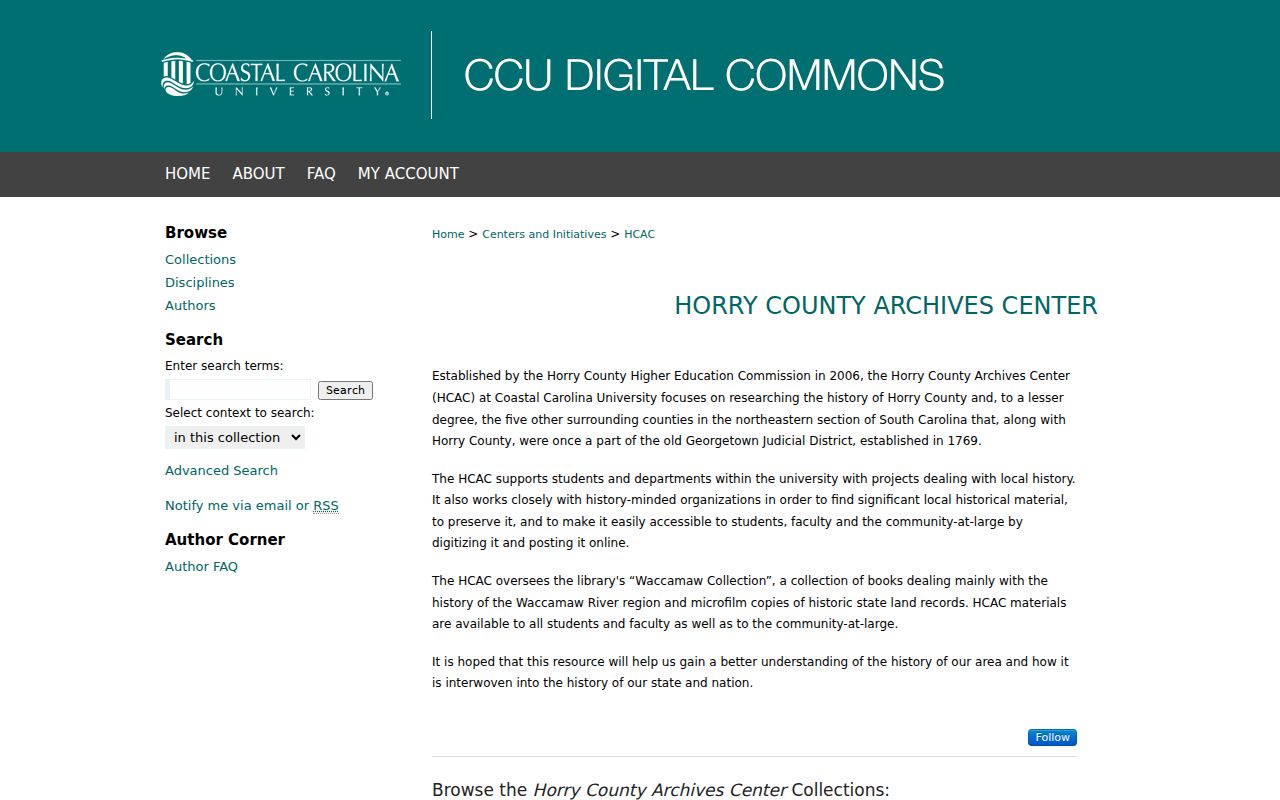
Archive descriptions, photograph captions, and oral histories can point toward a neighborhood, former business corridor, or community event. Preserve the collection title, item identifier, date, creator, and repository, then use the proper record custodian for a deed, court file, or certificate question.
Myrtle Beach Directory Research Fallback
When the library cannot confirm a local copy or a name requires older government material, the South Carolina Department of Archives and History is the statewide fallback. Its research room in Columbia offers a small library, microfilm, computers, catalog and index resources, copying facilities, and staff direction. The online catalog can be narrowed by creator, date, format, type, group, series, subject, county, and municipality.
Search Horry, Myrtle Beach, older community names, a surname, a subdivision, and a date span as separate terms. Catalog descriptions are not exhaustive, so one missing keyword result cannot prove a name or collection is absent. For very early heirship leads, the FamilySearch Horry probate catalog identifies records dated 1803 to 1873, but image availability and account conditions must be checked there at the time of research.
Myrtle Beach Directory Dates
The verified chronology is a set of dated materials, not a continuous publishing history. Keeping that distinction visible helps prevent one edition from being stretched into a broad claim about local residents.
| 1938-1949 | Eight Myrtle Beach Sanborn sheets were created for street, block, and structure context. |
|---|---|
| 1938-2017 | Chapin's in-library Digital Reel covers early Myrtle Beach newspapers and The Sun News. |
| 1959 | A Hill's edition and a Polk Myrtle Beach edition are bibliographically documented. |
| 1965 | A Polk Myrtle Beach edition is bibliographically documented. |
No documented record here confirms directory editions before or after those listed years, a publication gap, or a final printed edition. Verify the title at the repository before treating a date as available for consultation.
Tracing Myrtle Beach Directory Clues
For family history, use a historic directory as one dated point in a wider Myrtle Beach record trail. Begin with the confirmed volume, note the exact entry reference, then test the name or address against the in-library newspaper search and the relevant Sanborn sheet. If land is involved, a legal description or parcel identifier provides a safer bridge to a recorded instrument than an old address alone.
Federal census records are released on a 72-year cycle, with 1950 the latest released decennial census in 2026. That household snapshot can complement, but not replace, the 1959 or 1965 directory evidence. If a person may be deceased, an official probate route, a vital-record route, or a dated obituary notice can help test the trail. A person who no longer appears in a volume may have moved, been listed differently, fallen outside the directory's scope, or be missing from an unverified edition.